
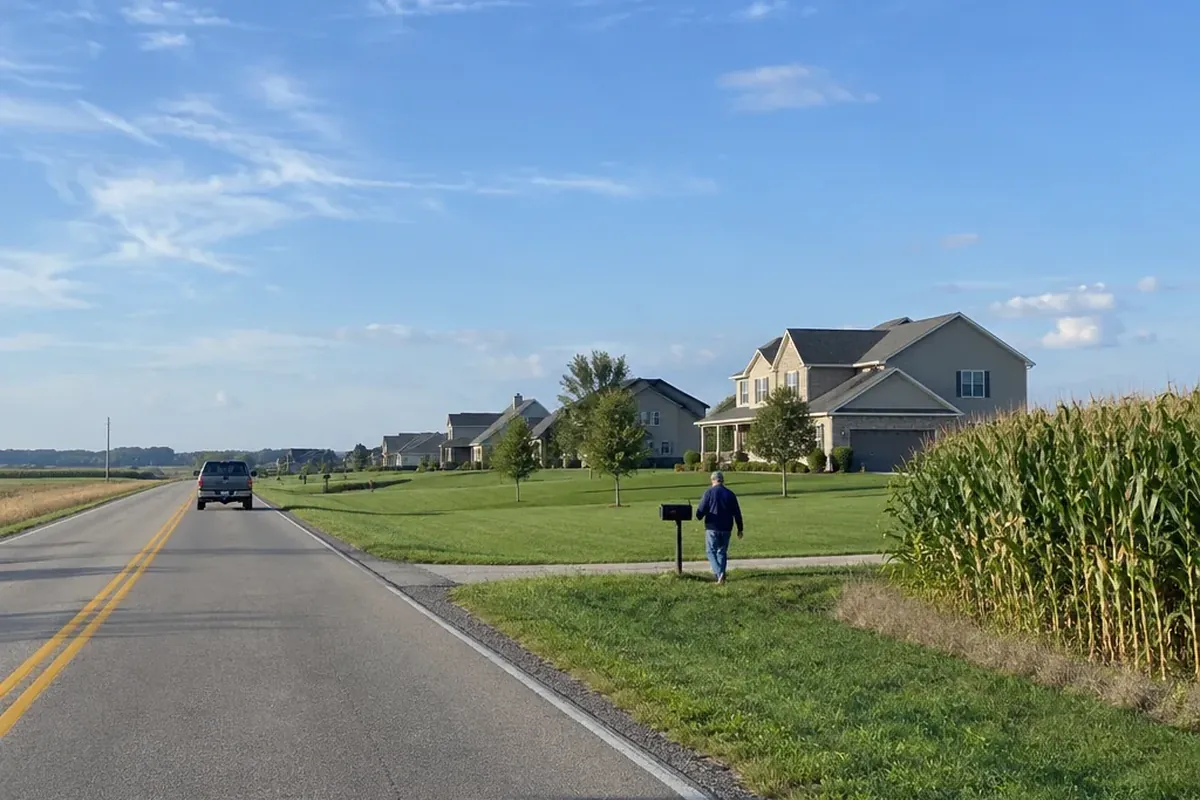
An exurb is a low-density, fast-growing community at the outer edge of a metropolitan area. It lies beyond the continuous suburban belt, yet its residents stay tied to the city through jobs and commuting. That makes it different from the countryside: homes may sit on large lots, but the local economy still runs on the urban core.
What an exurb means beyond the suburbs
Writer A. C. Spectorsky coined exurb in 1955 in his book The Exurbanites, combining “extra” and “urban.” The book was a satirical social history of commuters who worked in Manhattan’s advertising, media, and arts worlds. It described a new kind of place: outside the city and its established suburbs, but not outside the city’s influence.
Exurbs often leap beyond the unbroken residential development of a suburb into semi-rural land, where small towns, new housing, and open land share the same landscape. What defines an exurb is not an architectural style or a fixed mile marker. It is the place’s relationship to a major metropolitan area.
Exurb, suburb, and rural area: the key difference
A suburb is part of the built-up ring around a city. An exurb sits farther out, with much less development but ongoing economic links to the urban center. A rural area, by contrast, has little economic connection to a major city. Because the boundaries are fuzzy, two places at the same distance can be classified differently.
| Type of place | Physical pattern | Connection to the city |
|---|---|---|
| Suburb | Part of a continuous residential belt; more developed | Closely integrated with the metro area |
| Exurb | Lower-density development beyond that belt | Strong commuting and economic ties to an urbanized area |
| Rural area | Open, low-density land and smaller settlements | May have little direct connection to a major city |
The Brookings Institution described exurbs as places at the metropolitan fringe that are not yet fully suburban but no longer wholly rural. Its test has three parts: at least 20% of workers commute to an urbanized area, housing density falls in the lowest third of Census tracts, and population growth beats the average of the surrounding metro region. This is a practical research definition, not a universal rule.
How planners recognize an exurban place
Distance is a useful first screen, but it does not settle the question. The Census Bureau noted in 2024 that the fastest-growing places are increasingly 30 to 60 miles from the city hall of the core city. Planners often place a typical exurb roughly 35 to 50 miles from the core. Metro size and local geography can stretch or shrink that range.
Density shows why distance alone misleads. In Brookings’ analysis of 2000 data, the lowest-density third of Census tracts had at least 2.6 acres of land per resident. A typical exurban tract had 14 acres of land per home, compared with 0.8 acres per home nationally, a 17.5-fold difference. A place can therefore look rural while it functions as part of a metropolitan labor market.
The U.S. Census Bureau has no official definition of “exurb.” Its standard categories center on urban and rural areas. A June 2025 Census working paper did use a finer set of settlement types: Urban Core, Suburbs, Exurbs, Outlying Towns, and Rural. That label helps analysis, but it is not an official designation attached to every community.
Chicago’s exurbs show how wide the outer ring can be
Chicago makes the distance question concrete. A Brookings-based list of the region’s exurbs includes Bureau County (Princeton), DeKalb County (DeKalb), Grundy County, Kankakee County (Kankakee), and Kendall County.
DeKalb lies about 62 miles west of the Chicago Loop. Kendall County, which includes Oswego, is roughly 35 miles southwest, and Kankakee is about 56 miles south. These examples roughly match the broader 30-to-60-mile pattern, but not every community at that distance is an exurb. Commuting ties, density, and growth matter as much as mileage.
Why exurbs are growing
Housing costs are a major push. Brookings called the search for affordable homes at the edge of a region the “drive to qualify”: middle-income families move outward because they can afford more house there. After the pandemic began, rising housing costs pushed more people farther from cities in search of cheaper homes.
Remote work has changed the trade-off without removing it. The share of workdays done from home rose from under 1% in 1965 to about 7% in 2019, reached 60% in 2021, and settled near 28% in 2023. With fewer commute days, a homeowner may accept a longer trip on the remaining ones. Exurban and suburban counties added 931,000 residents in 2021 and another 832,000 in 2022. The population of exurban counties alone has grown 5.5% since April 2020, faster than any other county type.
The appeal of space comes with real trade-offs
For a buyer, exurban living can mean a larger tract of land, more privacy, and a quieter lifestyle than city life or a close-in suburb offers. But more space shifts the costs of daily life rather than removing them.
- Longer trips: Exurbs have the longest average one-way work commute of the main settlement types, 29.5 minutes, versus 26.6 minutes in early suburbs. They also have the highest share of car commuting in their regions.
- More infrastructure per resident: Per-capita infrastructure costs rise from $502 in the most compact quintile to $750 in the most sprawling quintile, an increase of about 50%.
- Land and climate pressure: Sprawl consumed more than 24 million acres of natural land between 2001 and 2017. U.S. passenger vehicles produced about 370 million tons of carbon-dioxide-equivalent emissions in 2021.
The right choice for a household depends on its work pattern, budget, and tolerance for driving, not on whether a place sounds suburban or rural.
Three common myths about exurbs
“An exurb is just another name for a rural area.”
No. Exurbs may look rural, but daily or frequent commuting and a metropolitan economy set them apart from places with little direct connection to a major city.
“Every faraway suburb is an exurb.”
Not necessarily. Mileage is not enough: low density, growth, and commuting flows are central to the common definitions.
“Exurbs all vote the same way.”
Brookings found in 2006 that political patterns in exurbs varied widely and did not form one consistent Republican bloc.
Frequently Asked Questions
What does “suburban development” mean?
Suburban development is the residential and related building in and around suburbs. Exurban development happens beyond the continuous suburban belt and is generally less dense.
What are considered suburbs?
Suburbs form the built-up ring around a city. They are usually more closely connected, physically and economically, to the urban center than an exurb is.
How far from a major city is an exurb?
There is no official distance. Fast-growing outer communities are increasingly 30 to 60 miles from the core city’s city hall, and planners often cite a range of 35 to 50 miles.
Why do people move to exurbs?
Common reasons are more affordable housing, larger lots, privacy, and a quieter lifestyle. Remote work makes a longer commute easier to accept when it happens on fewer days.
Does the Census Bureau define exurbs?
No. The Census Bureau has no official definition of an exurb, although a 2025 working paper used Exurbs as one category alongside Urban Core, Suburbs, Outlying Towns, and Rural.