
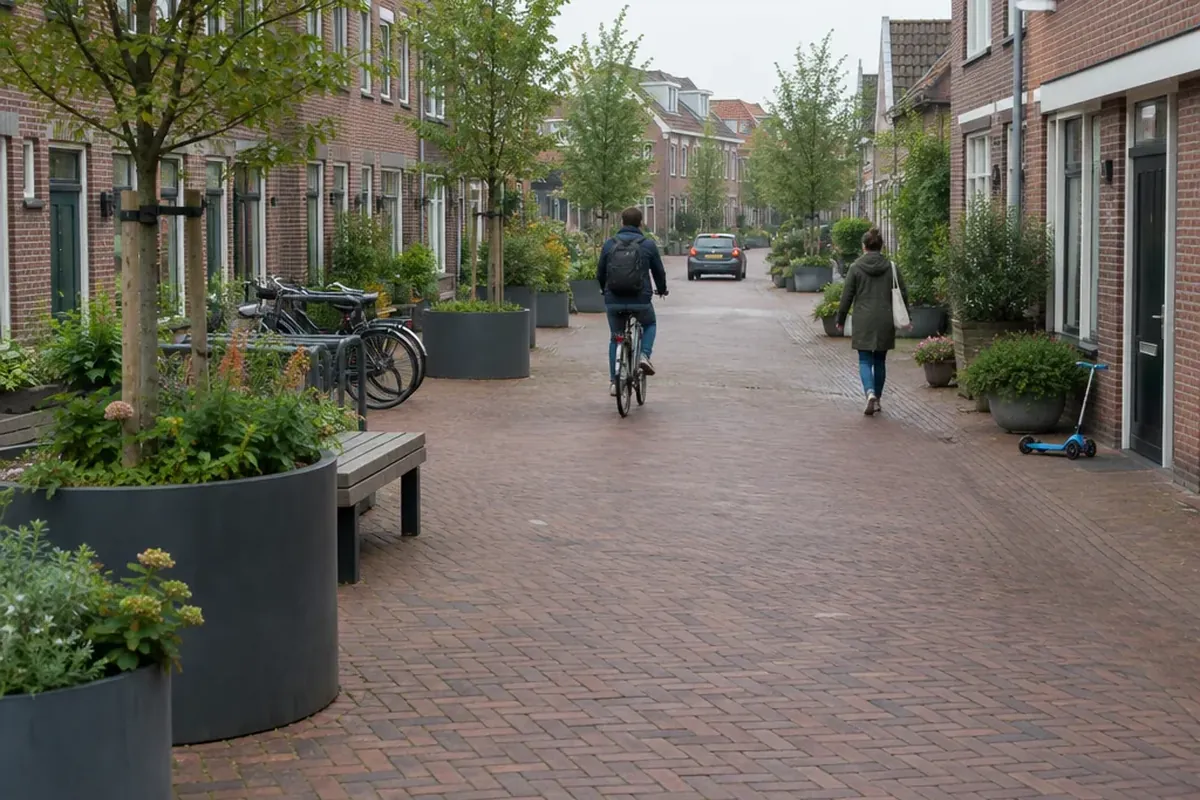
A woonerf is a Dutch living street: a residential street designed first as a place for people rather than a route for through-traffic. Cars are still allowed, but pedestrians have priority, may use the full width of the street, and children may play in the roadway. The goal is not to ban the automobile but to make the driver behave like a guest.
What a woonerf changes on an ordinary street
The Dutch word woonerf literally means “living yard,” and in English it is usually translated as “living street.” Instead of separating sidewalks on either side from a defined roadway, it turns the whole street into one shared space from edge to edge.
That change matters because design tells street users what to expect. A curb, a marked lane, and smooth asphalt signal movement and separation. On a shared surface, drivers, cyclists, and people on foot have to notice one another in the same public space. Dutch rules limit motor vehicles in a woonerf to 15 km/h (about 9 mph).
The plural is woonerven in Dutch and woonerfs in English. Local names show how far the idea traveled: the United Kingdom has “home zones,” Germany has the verkehrsberuhigter Bereich, and Norway has the gatetun.
From Emmen and Delft to a Dutch rule
Planner Niek de Boer developed the woonerf concept in 1968 for Emmerhout, a neighborhood of Emmen. He based the term on erf, the open yard around a house. His student Joost Váhl began applying the idea in 1969 to existing nineteenth- and twentieth-century streets in Delft.
Delft residents went further than discussion. They dug up street paving at night to create obstacles that forced cars to slow down, and in 1970 the city installed its first speed bump.
In 1976, the Dutch Parliament wrote woonerven into the national road design guidelines, the first legal framework of its kind in the world. Emmen itself was planned as a woonerf city during the 1970s. By 1999 the Netherlands had more than 6,000 woonerven, and an estimated 2 million Dutch people live in them.
How shared space makes drivers slow down
A woonerf relies on its physical layout more than on a speed-limit sign. At its core is a single paved surface: sidewalk and roadway sit at the same level, without the usual curbs and height changes. Removing familiar lane edges and asphalt cues breaks the driver’s impulse to move straight through at speed.
The route is then shaped by objects. Street trees, planters, bollards, bicycle racks, benches, and angled or parallel parking narrow the path and create a chicane effect. Instead of a broad corridor, a car gets a slow, curving line. At each entrance, a dedicated sign shows a pedestrian, a house, and a small car.
Four design principles work together
- Make the entrance visible. Drivers must recognize the transition before they enter.
- Use one continuous paved surface. The shared level removes the usual division between sidewalk and roadway.
- Place physical barriers deliberately. Planters, parking, and street furniture prevent a fast, straight run.
- Add greenery and furniture. Trees and places to sit make the street a place to stay, not just a path.
Accessibility needs specific attention. NACTO recommends tactile warning strips at entrances so people with visual impairments know they are entering an area shared with vehicles. For drainage, it recommends channels along the center of the street or at a shallow curb.
What the evidence says about safety and street life
The reported results are strong, but they are not a guarantee for every project. Dutch neighborhoods with woonerven saw traffic crashes drop by up to 70 percent. Studies from Western Europe found that injuries fell by more than 50 percent in traffic-calmed neighborhoods.
Half of all crashes involving children under five happen within 100 meters of their homes, yet very few happen on shared-surface streets. A German study found that street play increased by 20 percent after a conversion to a woonerf. Residents like the result: 70 percent of Dutch and 80 percent of British residents of woonerfs or home zones support them.
Seattle’s Bell Street Park shows how the model can be adapted in North America. Opened in 2014, the four-block project covers 56,000 square feet, uses continuous paving, and keeps a single 10-foot travel lane. After the redesign, daily traffic fell from 3,800 to 3,400 vehicles.
Why a woonerf is not a complete street
| Approach | How space is organized | What remains possible |
|---|---|---|
| Woonerf | A fully shared surface without the usual sidewalk-roadway separation | Vehicles enter slowly; pedestrians have priority |
| Complete street | May provide separated bike lanes, sidewalks, and travel lanes | Each user group can get dedicated space |
| Pedestrian zone | Reserved for people on foot | Motor traffic is generally excluded |
Shared space is the broader international term, and the woonerf is its specifically Dutch form. London’s Exhibition Road, for example, is a shared-space project that keeps a partial separation between sidewalk and roadway.
What a living street must solve before it is built
Woonerfs can be built as retrofits. Because planters, benches, and bollards can simply be added, a redesign does not always require major demolition. A credible plan still starts with resident participation and formal approval by the city council.
Access for fire trucks, garbage collection, and ambulances has to be planned from the start. Cost is another constraint: more complex construction, greenery, and street furniture can make a woonerf more expensive to build and maintain than a conventional street. Critics also point to slower emergency response, traffic shifting to neighboring streets, lost parking, and wayfinding or parking problems for visitors and delivery drivers.
Common myths obscure the woonerf concept
Myth: It is a pedestrian mall
No. Vehicles are allowed in a woonerf, but their status and speed change. In the Netherlands, pedestrian priority and the 15 km/h limit set it apart from an ordinary street.
Myth: Signs alone create a living street
No. In Hesselterbrink, a district of Emmen, critics noted that standard signs without real places to linger reduce the idea to traffic control. Shared paving, obstacles, greenery, and furniture are the core of the design.
Myth: Every shared-space project is a woonerf
No. Shared space is the umbrella term. A woonerf is the Dutch model in which the usual separation of roadway and sidewalk disappears entirely.
Frequently Asked Questions
How do you pronounce “woonerf”?
In Dutch it sounds roughly like “VOH-nerf.” For American English, the Cambridge Dictionary gives /ˈvuː.nɝːf/.
What are woonerfs?
Woonerfs are residential streets where pedestrians have priority, vehicles are still permitted, and the surface is shared instead of divided into sidewalk and roadway.
How do woonerfs share space between pedestrians, cyclists, and cars?
They use one paved level plus physical features such as trees, planters, bollards, parking bays, bicycle racks, and benches that slow and redirect vehicles.
Where did woonerfs originate?
The concept began in 1968 in Emmerhout, Emmen, was applied to existing streets in Delft from 1969, and gained legal status in the Netherlands in 1976.
What is the Woonerf app?
Woonerf is also the name of a parking-payment app for Hartford, Connecticut. It runs on iOS and Android through the Passport Parking platform and has nothing to do with the street-design concept.