Urban renewal is the rebuilding or rehabilitation of declining parts of a city, usually through public action, private investment, or both. It lets cities repair infrastructure, add housing and public space, and bring investment back to a neighborhood. In the United States, however, the same label also carries the history of clearance, demolition, and forced relocation.
What urban renewal means and why its history still matters
In practice, urban renewal covers initiatives that address urban decay, upgrade infrastructure, and revitalize city neighborhoods. Historically, projects often began by designating an area as “blighted,” then clearing land for new housing, businesses, or public spaces. The term entered federal policy with the 1954 amendment to the Housing Act of 1949, which broadened an earlier focus on slum clearance to include rehabilitation and code enforcement.
Urban renewal reshaped American cities on a vast scale
From 1949 to 1974, more than 1,200 US places undertook 3,300 federally funded projects. Governments spent $20 billion; the program cleared 156 square miles, demolished 280,000 buildings containing 450,000 residences, and forced 114,000 small businesses to move.
Under the Housing Act of 1949, Title I authorized $1 billion in loans to acquire slums and blighted land, plus grants of $100 million a year for 5 years. In Berman v. Parker in 1954, the Supreme Court ruled 8–0 that eminent domain could serve urban renewal under a broad reading of public use.
Highway building added to the disruption. The 1956 Federal-Aid Highway Act paid 90% of interstate costs, and interstate construction from 1956 to 1967 displaced roughly 330,000 urban households, often in the same communities urban renewal had already targeted.
When redevelopment broke communities instead of renewing them
The human cost was displacement. In HUD data analyzed in a 2024 study, the total was about 334,000 families and 169,000 single-person households, or roughly 1.36 million people. By another estimate, 60% of those forced to move were Black and two-thirds were renters. Of more than $13 billion in federal investment, relocation assistance made up only 0.4% of gross costs.
Boston’s West End shows the scale behind those totals. In 1958, the Boston Redevelopment Authority designated the dense Italian and Jewish working-class area for complete clearance. Nearly 900 buildings were demolished, displacing more than 20,000 people for luxury high-rise apartments and Government Center. Superblocks replaced the original street grid. The West End demolition became a national symbol of renewal’s excesses, and Government Center is still widely criticized as an example of failed planning.
In Pittsburgh, clearance of the Lower Hill District began in 1955. More than 8,000 residents, most of them Black, were displaced, and 400 businesses across 95 acres were wiped out. The cleared land became the site of the Civic Arena, which opened in 1961 and was demolished in 2011 after decades of criticism that the neighborhood had not recovered.
The economic case has gains, costs, and a distribution problem
NBER research found higher median incomes and property values in cleared areas by 1980. Those gains largely went to new residents rather than displaced people. Federal land write-downs and FHA loans let developers acquire parcels with cash investments as low as 3%.
A 1964 Census survey found that displaced families faced higher housing costs and longer commutes after relocation. In some places, cleared acreage sat vacant for years as costs rose, leaving “urban holes” in city centers.
| What a project can add | What it can take away |
|---|---|
| Infrastructure, investment, and higher property values | Homes, small businesses, and established social ties |
| New housing and public space | Affordability for displaced renters and owners |
| Land assembled for a large plan | Street networks and community political power |
Local government determines whether residents have power
Local governments applied for federal grants, acquired property through eminent domain, contracted with developers, and carried primary responsibility for relocation.
From 1970, the Uniform Relocation Act and later state laws required documentation of displacement, relocation help, and replacement housing before demolition. In 1974, the Housing and Community Development Act replaced the federal program with Community Development Block Grants (CDBG), which shifted the emphasis from demolition to rehabilitation.
How today’s renewal can support existing residents
Inclusionary zoning can require developers to include affordable housing units. Community benefits agreements bind developers by contract to commitments made to community organizations. Right-to-return programs give displaced residents first priority in new housing.
For environmental sustainability, projects can use green building standards, brownfield remediation, rain gardens, permeable pavement, and urban tree canopy. After the 1990s, transit-oriented development emerged in response to congestion, class division, and urban sprawl. Resident-led workshops and transparent decisions help ensure that renewal benefits existing residents rather than displacing them.
Seven types of urban planning put renewal in context
Renewal is closest to urban revitalization, one of seven commonly listed types of urban planning:
- Strategic urban planning sets high-level goals and growth areas.
- Land-use planning uses zoning, laws, and regulations.
- Master planning lays out greenfield development from scratch.
- Urban revitalization improves declining areas.
- Economic development seeks businesses and investment.
- Environmental planning addresses sustainability, pollution, and habitats.
- Infrastructure planning covers roads, utilities, and public facilities.
Urban revitalization can repair roads, expand infrastructure, clean pollution, and add parks. Community participation is considered crucial, a different starting point from the mid-20th-century bulldozer model.
Common myths hide the real trade-offs
Myth: Renewal and gentrification are the same thing
They are related but distinct. Gentrification is neighborhood change involving real-estate investment, higher-income newcomers, and demographic change in historically disinvested areas. Urban renewal helped set the stage for it: clearance and later disinvestment preceded reinvestment that priced out long-term residents.
Myth: New buildings prove a project succeeded
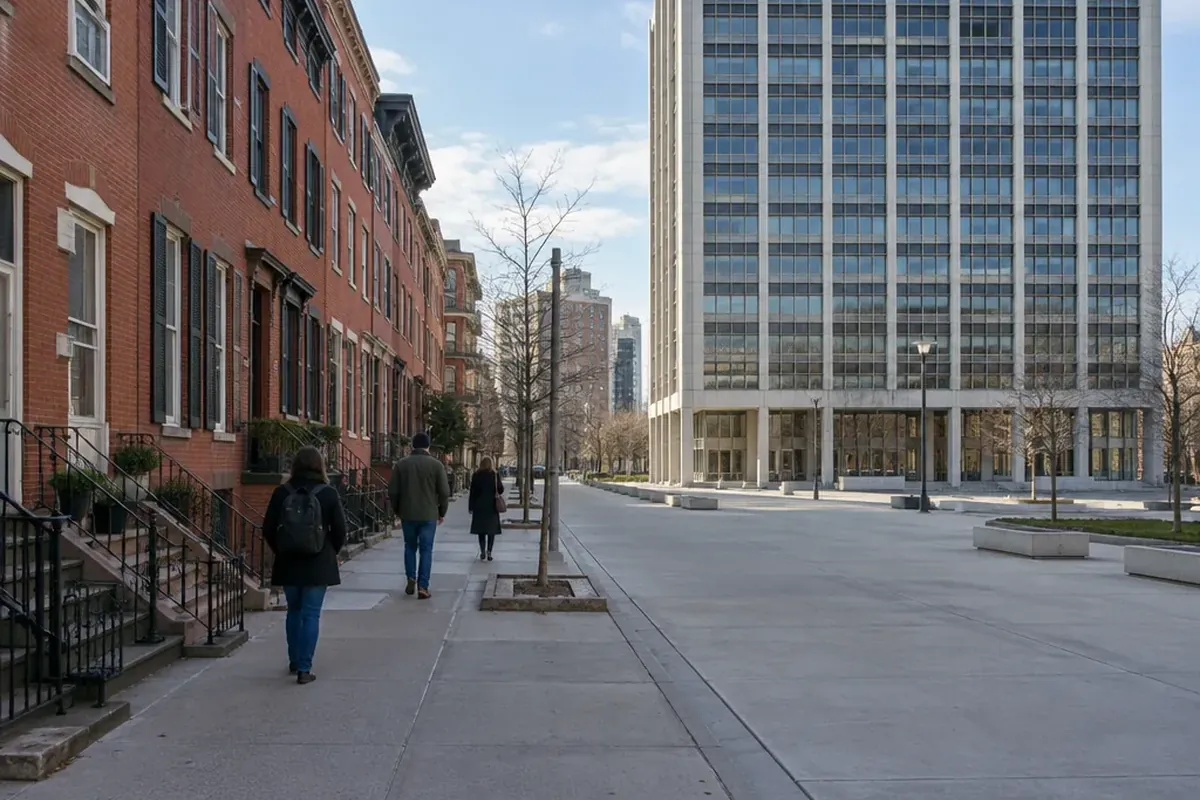
New construction can coexist with lasting harm. In Southwest Washington, DC, roughly 23,000 residents and 1,500 businesses were displaced while 95% of structures were demolished. The challenge to this redevelopment led to Berman v. Parker. The rebuilt area became known for mid-century modern towers and superblocks, a design civic leaders later called a mistake.
Myth: Relocation solves displacement
Relocation changes more than an address. Earlier displaced families faced higher housing costs and longer commutes, and communities lost businesses, social ties, and political influence. Psychiatrist Mindy Fullilove calls the trauma of losing homes and community ties “root shock.”
Frequently Asked Questions
What does “urban renewal” mean?
It means public or private efforts to address urban decay by upgrading infrastructure and rebuilding or rehabilitating neighborhoods. In US history, it often involved clearing areas labeled blighted and replacing them with new uses.
What are some examples of urban renewal projects?
Boston’s West End, Pittsburgh’s Lower Hill District, and Southwest Washington, DC are well-documented US examples of large-scale demolition and displacement. Later approaches follow a different model: rehabilitation instead of clearance, transit-oriented and mixed-use development, and community participation in planning.
How can urban renewal avoid displacement?
Inclusionary zoning, community benefits agreements, right-to-return programs, replacement housing before demolition, and resident participation can keep existing residents central to redevelopment decisions.
What is urban regeneration in GCSE geography?
In GCSE Geography, urban regeneration is the improvement of run-down or neglected parts of a city or town through public or private investment that brings derelict and deprived areas back to life.
What brand is Urban Renewal?
Urban Renewal is Urban Outfitters’ apparel and home-goods division. It sells one-of-a-kind vintage, recycled, and reworked pieces and uses deadstock fabrics and merchandise for upcycled items.