
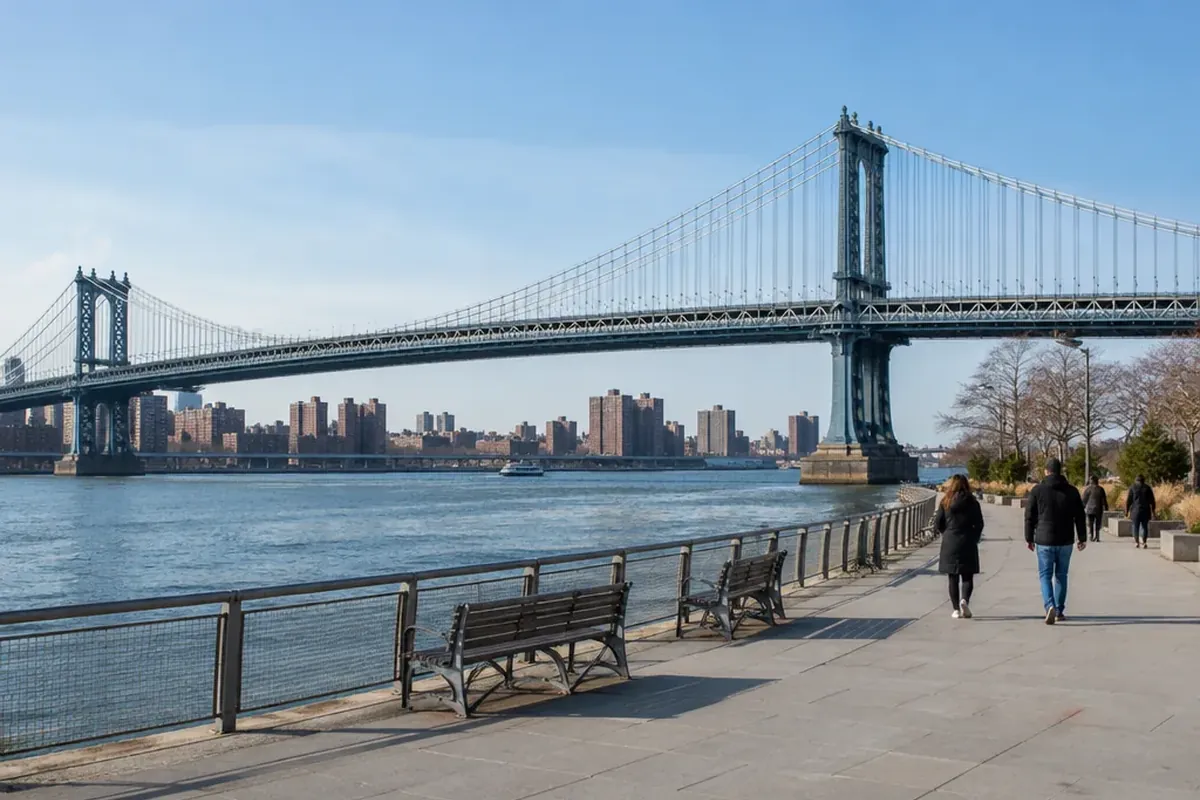
Robert Moses (1888–1981) was the unelected public official who gave modern New York much of its physical shape: beaches and playgrounds, parkways and bridges, expressways and civic sites. He got projects built at extraordinary scale, but the same machinery that produced those public works also demolished neighborhoods and escaped public accountability. That is why he is both admired and criticized: his career raises the question of who gets to decide what a city builds.
What Robert Moses built across New York
Moses built at a scale few urban planners have matched. By the end of his career, he had presided over 13 major bridges, 416 miles of parkways, 658 playgrounds, 17 swimming pools, and more than 100 parks. As New York City Parks Commissioner from 1934 to 1960, he oversaw park acreage that more than doubled to 34,673 acres. When he started, the city had just 119 playgrounds.
His work joined recreation, roads, and real estate into one regional vision. Jones Beach State Park opened in August 1929, drawing 350,000 visitors in its first month and eventually becoming the nation’s most visited public beach. On Long Island, the Northern State, Southern State, Wantagh, and Meadowbrook parkways were designed for passenger cars only, with no room for buses or trucks. Moses made the landscaped, park-like parkway the backbone of his regional road system.
- Bridges: the Triborough Bridge, Bronx-Whitestone Bridge, Throgs Neck Bridge, Henry Hudson Bridge, and Verrazzano-Narrows Bridge.
- Highways: the Cross Bronx Expressway, Brooklyn-Queens Expressway, Long Island Expressway, Gowanus Expressway, Prospect Expressway, Whitestone Expressway, and Clearview Expressway.
- Civic projects: the Brooklyn-Battery and Queens-Midtown tunnels, the United Nations headquarters site, Lincoln Center, the 1964 New York World’s Fair, and Shea Stadium.
The Verrazzano-Narrows Bridge, opened on November 21, 1964, had a 4,260-foot central span, then the world’s longest for a suspension bridge. Moses himself never learned to drive and rode his hundreds of miles of highway as a passenger.
Why the power broker could act without winning elections
Robert Moses was never elected to office, but at his peak he held as many as 12 titles at once. He was chairman of the New York State Council of Parks from 1924 to 1963, New York City Parks Commissioner, president of the Long Island State Park Commission, and chairman of the Triborough Bridge Authority. He kept his influence through six New York governors and five New York City mayors.
His decisive advantage was money as much as office. Toll revenue from the Triborough Bridge supported a public authority that could issue bonds, allowing it to fund projects outside ordinary voter-approved budgets and legislative oversight. By 1946, the authority could borrow $360 million against toll revenue, more than twice New York City’s $150 million borrowing limit.
He also cultivated political leverage. Moses kept dossiers on politicians, journalists, and opponents, and distributed legal, insurance, and construction work to allies. Robert Caro’s account describes authorities such as the Triborough Bridge and Tunnel Authority as a “fourth branch of government,” with records closed to public scrutiny.
The human cost behind the expressway map
Moses is controversial because his projects treated clearance as a technical means to a public end, while residents experienced it as the loss of homes, businesses, and community. Across his highways and urban-renewal work, an estimated 250,000 to 500,000 people were displaced in New York City. Black and Puerto Rican communities were disproportionately affected, reinforcing racial segregation; the redevelopment plans did not create enough low-income housing to relocate every household uprooted.
The Cross Bronx Expressway shows the scale in one corridor. Built between 1948 and 1963, it displaced an estimated 40,000 to 60,000 people and demolished 159 streets. For Lincoln Center, the clearance of the predominantly Puerto Rican San Juan Hill neighborhood displaced more than 2,000 families. Moses called it “the worst slum in New York,” but that label did not lessen the disruption for people who lived there.
Jane Jacobs exposed the limits of top-down planning
In 1955, Moses proposed the Lower Manhattan Expressway, a 10-lane elevated highway through Greenwich Village, SoHo, and Little Italy. Jane Jacobs, a local writer and activist, helped organize the Joint Committee to Stop the Lower Manhattan Expressway. Residents, businesses, and preservationists made the fight a public argument about whose city was being planned.
Jacobs’s 1961 book The Death and Life of Great American Cities offered a direct intellectual challenge to car-centered, top-down planning. Moses dismissed it as “intemperate and inaccurate” and “libelous.” They met only once; his side relied on bureaucratic power, while hers mobilized public opinion. Mayor John Lindsay formally killed the expressway in 1969, a turning point against Moses’s model of urban renewal.
Robert Moses myths and the documented record
| Claim | What the record supports |
|---|---|
| Moses was an elected master builder. | He was never elected. His authority came from appointed posts and public authorities. |
| His legacy was only destructive. | He expanded parks, playgrounds, pools, bridges, and regional access, while his renewal and highway projects caused large-scale displacement. |
| Low parkway bridges prove one settled intention. | Caro reported an allegation that low Southern State Parkway overpasses were meant to exclude buses carrying poor Black and Puerto Rican riders. The story is contested: engineering standards and comparable clearances on other period parkways complicate the claim. |
A contested allegation should not erase the documented exclusion of buses from Moses’s Long Island parkway design, nor should it be presented as proof beyond the available evidence.
What The Power Broker argues about New York
Published in 1974, Robert Caro’s The Power Broker: Robert Moses and the Fall of New York is a 1,336-page biography that won the 1975 Pulitzer Prize for Biography. Caro spent seven years researching it and conducted hundreds of interviews. Beyond one builder’s life, the book explains how institutional power can accumulate beyond democratic control.
Caro argues that Moses moved from idealistic reformer to power-hoarding builder, privileging automobiles over people, highways over neighborhoods, and authority over accountability.
Why Moses still matters to urban planning
Moses personally carried through public works costing $27 billion in 1968 dollars. Revisionist historians argue that his infrastructure helped keep New York among the world’s leading cities and that its physical systems remain indispensable. Critics point instead to Jacobs’s ideal of lively streets, transit access, and incremental growth.
Frequently Asked Questions
What is Robert Moses most known for?
He is most known for reshaping New York through parks, beaches, parkways, bridges, highways, playgrounds, and major civic projects. His record includes 13 bridges, 416 miles of parkways, and 658 playgrounds.
Why was Robert Moses so powerful?
He combined numerous appointed offices with the Triborough Bridge Authority’s toll-backed bond revenue. That independent financing let him build projects with far less direct budgetary and legislative control than elected city government faced.
How many people did Robert Moses displace?
Estimates for his highways and urban-renewal projects across New York City range from 250,000 to 500,000 people. The Cross Bronx Expressway alone displaced an estimated 40,000 to 60,000 people.
Where was Robert Moses born?
He was born in New Haven, Connecticut, on December 18, 1888. His family moved to New York City in 1897.
Is Robert Moses State Park or Field 5 open today?
Robert Moses State Park, an 875-acre park on Fire Island, is open year-round from sunrise to sunset. For the current status of individual fields such as Field 5, check the alerts from New York State Parks before you go.