
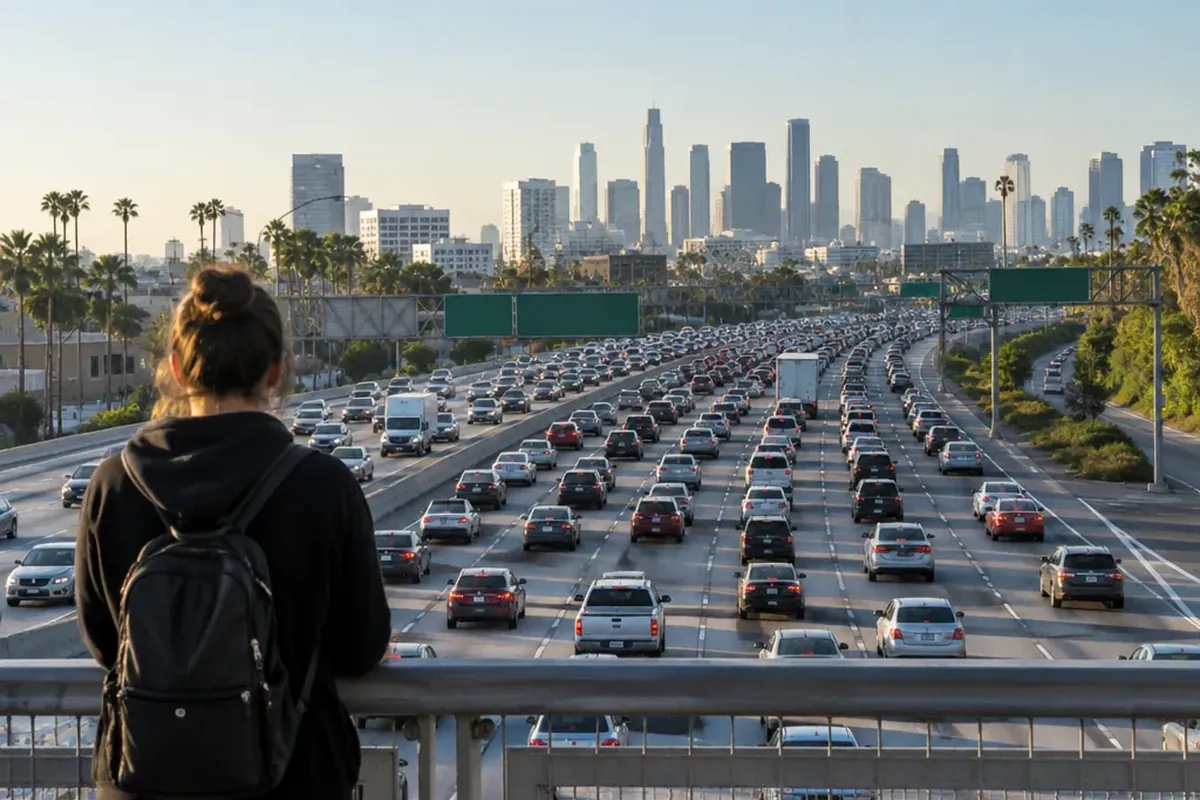
Induced demand is the reason a wider road can briefly move faster and then fill up again: lower travel times make driving more attractive, bringing additional trips onto the facility until congestion returns toward its earlier level.
What the induced demand paradox actually says
The induced demand paradox describes how highway expansion relieves traffic congestion initially, while that relief creates the conditions for more driving. In 1962, Anthony Downs formulated the underlying pattern: on urban commuter expressways, peak-hour traffic congestion rises to meet maximum capacity. Hence the familiar shorthand: “You can’t build your way out of congestion.”
In their 2011 study, Duranton and Turner found vehicle miles traveled rising roughly one-for-one with interstate lane miles, with an elasticity of about 1.03. A 10 percent increase in interstate lane kilometers was associated with roughly a 10 percent increase in vehicle kilometers traveled. To test whether roads cause traffic rather than merely anticipate it, the researchers used historical exploration routes, rail routes, and the original interstate plan as instruments. They called this proportional response the fundamental law of road congestion.
Why wider highways induce more traffic
After a congested roadway is widened, the immediate change is a lower time cost for driving. This improvement triggers triple convergence: drivers switch routes, shift from off-peak to peak times, or change modes of transportation, including from transit or biking to driving. Such short-run changes typically occur within one to five years.
- Route shifts: drivers leave parallel streets or other highways for the newly faster corridor.
- Time shifts: people who avoided the peak hour return to it.
- Mode shifts: trips that used public transportation, biking, or another mode move into cars.
- More and longer trips: lower travel times lead to more frequent errands and travel to farther destinations.
In the long run (beyond five years), land-use patterns change: households move farther from city centers, businesses relocate, and development spreads along the improved corridor. Duranton and Turner attributed about half of induced vehicle travel to individual behavior changes, with the rest split between more commercial trucking and migration toward better-supplied road networks.
In a 1999 paper for the Federal Highway Administration’s Highway Economic Requirements System, Lee, Klein, and Camus separated induced traffic from induced demand. In the short run, induced traffic is the increase as existing residents make new trips because a road is faster. Over the longer run, induced demand is the increase as new residents move to an area because the road exists.
Latent demand is not the same as new demand
Latent demand is pent-up travel already suppressed by congestion. Rather than use a slow road, someone who would use it if it were faster takes another route, travels at another hour, or chooses another mode. Once conditions improve, that traveler returns. On a supply-and-demand diagram, this represents movement along the existing demand curve.
By contrast, induced demand did not exist before the improvement. Economically, that is an outward shift of the demand curve. Standard four-step forecasting models can capture route reassignment and mode shifts, but are generally less sensitive to wholly new trips.
| Question | Latent demand | Induced demand |
|---|---|---|
| What existed before expansion? | A suppressed desire to travel | No equivalent trip or long-run location choice |
| Economic description | Movement along an existing demand curve | Outward shift of the demand curve |
| Typical response | A traveler changes route, time, or mode | New trips, longer distances, or relocation create more travel |
| Planning challenge | Estimate reassignment accurately | Account for travel that was not in prior patterns |
Houston and Los Angeles show how fast relief can fade
Houston’s Katy Freeway added lanes, then lost time
From 2008 to 2011, the Katy Freeway (I-10 west of Houston) was widened at a cost of $2.8 billion, creating up to 26 total lanes: 12 main lanes, eight feeder-road lanes, and six managed lanes. By 2014, three years after completion, morning commute times had increased by 25 minutes (30 percent) compared with 2011, and afternoon commute times had increased by 23 minutes (55 percent).
In 2014, a 29-mile peak-hour commute from suburban Pin Oak to downtown Houston could take up to one hour and 50 minutes on the Katy, despite its width.
The I-405 gained a carpool lane while travel times rose
Through the Sepulveda Pass, Los Angeles added a northbound carpool lane along 10 miles between I-10 and US-101. Construction lasted from 2009 to 2014 and cost more than $1.6 billion. Immediately after opening, average travel time on the segment increased from 34.5 to 35.5 minutes compared with the previous year.
By 2019, northbound evening speeds had fallen from 28 mph in 2015 to 19 mph, while travel time rose from 23 to 34 minutes, a 50 percent increase. Relative to a no-project counterfactual, Metro estimated that the project reduced delay, yet observed travel times still increased.
Removing capacity can make some traffic disappear
The opposite of induced demand is reduced demand, often called traffic evaporation or disappearing traffic. When capacity is removed, displaced vehicles do not simply reappear on adjacent streets; instead, people change routes and times, switch modes, or forgo discretionary trips.
A UK study of more than 100 cases of road-capacity reduction across Europe, North America, Japan, and Australia found an average 25 percent reduction in motorized traffic, even after diversion to parallel routes was counted. In 2003–2004, Seoul demolished the 10-lane road and four-lane elevated highway over the Cheonggyecheon, which had carried more than 170,000 vehicles each day, and restored the stream beneath them.
From 2003 to 2008, vehicle traffic in the area fell about 45 percent, bus ridership rose 15.1 percent, and subway ridership rose 3.3 percent.
How transportation agencies can reduce congestion without widening roads
After finding that road capacity expansion and transit extensions did not reduce metropolitan VMT, Duranton and Turner concluded that congestion pricing was the main candidate tool. Pricing manages demand by altering the cost of driving when and where road space is scarce.
In its first year, London’s congestion charge, introduced in 2003, reduced traffic entering the central zone by about 15 percent and congestion (measured in delay) by about 30 percent. In New York City, the Central Business District Tolling Program, launched in January 2025, reduced vehicle entries into Manhattan’s core by 27 million in its first year, an 11.7 percent drop.
Another option is reallocating road space. In a review of more than 70 cases that shifted space from cars to buses, bikes, or walking, traffic fell in 51 of 62 measured results, with a median drop of about 11 percent on the treated road or area.
Common myths hide the real planning choice
Induced demand does not make every road project pointless
Induced demand is most relevant on congested urban highways. Rural roads and uncongested corridors can improve accessibility without generating proportional new traffic.
Induced-demand estimates do not all say the same thing
Critics note that studies relying on 1983–2003 data need updating. The Federal Highway Administration cautions that lane-mile studies can produce inflated elasticities when they overlook the role of congestion. In a meta-analysis of 25 papers, the average elasticity was 0.2 in the most realistic specifications, leaving room for meaningful congestion relief.
More trips are not automatically a failure
For travelers, additional trips can generate consumer surplus and economic benefits when people value the mobility provided. Highway advocates argue that benefit-cost analysis should weigh these benefits against project costs and congestion effects, rather than applying a blanket rejection of road expansion.
Frequently Asked Questions
What is the induced demand paradox?
It is the pattern in which extra road capacity initially lowers travel time, then attracts enough additional travel to restore congestion toward its earlier level.
What is the opposite of induced demand?
The reverse effect is reduced demand, also called traffic evaporation or disappearing traffic. When road capacity is removed, a portion of travel shifts modes, changes time, or ceases rather than simply diverting to another road.
What does supplier-induced demand mean?
Supplier-induced demand describes a supplier using superior information or market power to encourage consumption beyond what is efficient. In transportation, agencies and highway builders can over-forecast demand to justify new projects.
What causes induced demand in transportation?
Added capacity lowers the time cost of driving. In the short run, drivers shift routes, times, and modes; in the long run, additional trips, longer travel distances, commercial trucking, and outward development increase traffic volumes.
How can transportation agencies reduce congestion without expanding roads?
Congestion pricing manages peak demand by pricing scarce road space, while reallocating road space to buses, bikes, or walking accommodates travel without expanding highway lanes.