
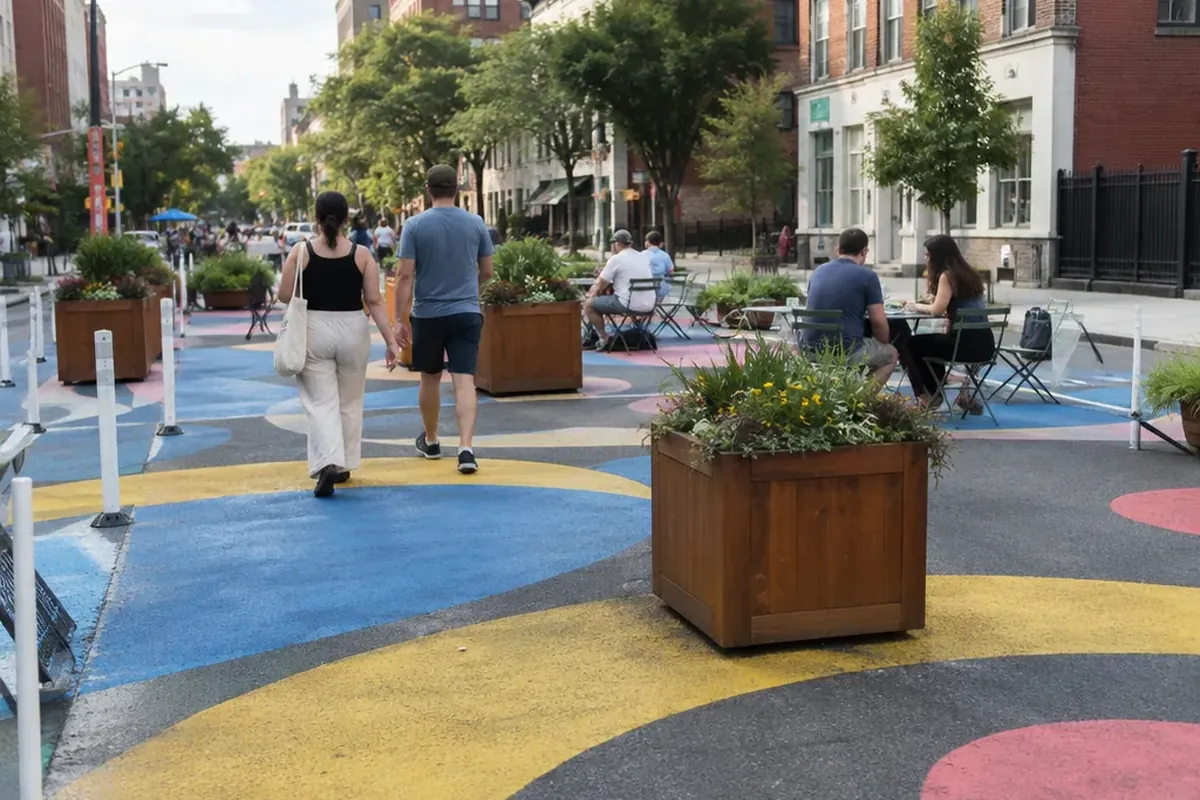
Tactical urbanism is a way to test a better street or public space before committing to permanent construction. A city, organization, or residents make a short-term, low-cost change, watch how it works in real life, and use that evidence to decide what should come next. The point is not temporary decoration; it is a practical experiment that can catalyze long-term change.
Tactical urbanism theory turns a small test into a planning decision
Tactical urbanism is an approach to neighborhood building through short-term, low-cost, and scalable interventions. It is also called DIY urbanism, planning-by-doing, urban acupuncture, or urban prototyping. A project might last a few hours or days; an interim installation can remain for weeks or months. Some cities define a demonstration as lasting up to 30 days and a pilot as lasting from one month to one year.
Mike Lydon and Anthony Garcia describe five defining characteristics: a deliberate, phased approach; local solutions for local challenges; a short-term commitment as the first step; lower risk with potentially high reward; and social capital built between residents and institutions. A tactical intervention should answer a real local question and feed a larger decision, rather than simply create an event.
The term appeared in a June 2010 blog post about pedestrianizing Times Square, where NYC DOT’s work was described as “tactical interventions.” Lydon adopted the phrase after co-founding Street Plans Collaborative in 2009. A free Tactical Urbanism e-book released in 2012 drew more than 10,000 downloads in less than two months; Lydon and Garcia’s book Tactical Urbanism: Short-Term Action for Long-Term Change followed in 2015.
From a parklet to a bike lane: common tactical urbanism projects
The form follows the question being tested. Is a crossing too long? Does an underused slip lane have more value as a plaza? Would people use a protected cycling route? Common projects include pop-up bike lanes, parklets, pavement-to-plaza conversions, open streets, curb extensions, walk lanes, lane narrowing, and demonstration bike lanes.
| Project type | What it tests | Typical temporary elements |
|---|---|---|
| Parklet | Whether one or two curbside parking spaces can serve people instead | A platform, seating, planting, and bike racks |
| Pavement-to-plaza | Whether underused road space can become a pedestrian plaza | Paint, planters, flexible posts, and movable tables and chairs |
| Open streets | How a route works when cars are temporarily excluded | Street closures and traffic control |
| Pop-up bike lane | Whether dedicated space improves a cycling connection | Paint, tape, signs, or barriers |
| Curb extension | Whether a shorter crosswalk improves a difficult crossing | Paint, posts, or planters |
Materials can be deliberately reversible: spray chalk lasts days, acrylic asphalt paint months, and preformed thermoplastic one to three years. Flexible materials are cheaper and easier to remove than permanent construction, but require more maintenance.
Open streets have the longest record. Bogotá’s first Ciclovía, on December 15, 1974, closed two streets for three hours and drew more than 5,000 people. The program has grown to 120 to 127 kilometers of roads closed to cars every Sunday and public holiday, with one to two million participants per event, and more than 100 cities have copied it.
A famous example began with one parking space
For Park(ing) Day in San Francisco in 2005, the design collective Rebar rented a metered space for two hours and placed live turf, a bench, and a potted tree in it. The small act made a concrete question visible: must every curbside space serve vehicle storage? In 2011, the annual event reached 935 initiatives in 162 cities. San Francisco’s Pavement to Parks program turned the one-day idea into a standard permit model in 2010.
What real-world tests have revealed about streets and public space
In May 2009, NYC DOT closed Broadway at Times Square with paint, orange barrels, and 376 beach chairs bought for $10.74 each. The six-month reversible pilot became permanent in February 2010. After the Broadway corridor changes, New York City reported 63% fewer motorist and passenger injuries, 35% fewer pedestrian injuries, 11% more pedestrians in Times Square, and a 17% improvement in northbound travel time. Those results belong to that corridor, not a promise that any plaza will produce the same outcome.
Dallas offered a different scale. On April 10–11, 2010, Oak Cliff residents used roughly $1,000 in mostly borrowed materials to remake a car-oriented block for a weekend. Paint created bike lanes; potted saplings, outdoor furniture, and pop-up businesses changed how the block could be used. The Better Block showed a possible street design before a capital project existed.
In Milan, Piazze Aperte has implemented around 60 interventions since 2018, creating about 56,000 square meters of pedestrian areas. At Piazza Angilberto II, monitoring found a 47% increase in cyclists and a 30% rise in pedestrian use. A tactical project can make a proposal legible enough for people to judge it with their feet, but its effects still need to be measured locally.
Start a tactical urbanism project by defining the decision it must test
A sound tactical urbanism project is organized around a limited question, such as whether a safer crossing, a bus-stop improvement, or a different lane arrangement works at one site. The four-stage process keeps the project from becoming an unmeasured pop-up.
- Select the site. Look for places that connect destinations people visit, follow pedestrian desire lines, and have a clear problem to test. Check road conditions and whether construction is scheduled.
- Appraise the context. Observe how the site functions at different times. Account for walking, cycling, loading, vehicular traffic, access, and the existing condition of the street.
- Design and prepare. Set the duration and evaluation criteria before installation. Assign responsibility for fundraising, design and construction, coordination and logistics, communications, and documentation.
- Implement and evaluate. Record use and operational problems, gather feedback from affected people, then decide whether to adjust, extend, remove, or pursue a permanent version. Reuse or distribute materials after removal where possible.
Do not use a short-term installation to evade hard conditions. Waterlogged or broken surfaces, missing basic utilities, a parking shortage, and street crime are underlying problems that tactical urbanism cannot fix.
Atlanta’s guide shows what a permitted project requires
Atlanta released its first Tactical Urbanism Guide in fall 2020 through the Department of City Planning and the Atlanta Department of Transportation. It gives communities step-by-step direction to fund, lead, design, and implement demonstration projects. The original eligible types were crosswalk art, curb extensions, parklets, slow streets, traffic signal box art, and walk lanes. A 2022 update added types including tactical slip lane closures, demonstration bike lanes, bus stop enhancements, pedestrian space art, and lane narrowing.
Atlanta distinguishes a demonstration of 30 days or less, using easily removed materials, from a pilot lasting more than one month and less than one year. Requirements include 20 feet of clearance for emergency vehicles, 15 feet around fire hydrants, three community-support letters, an insurance certificate, a traffic-control plan, and ADA/MUTCD compliance. ATLDOT review takes five to 10 days. Projects in equity areas may be able to borrow city cones, barricades, and signage at no cost.
That structure matters: a citizen-led idea can be ambitious without ignoring access, emergency operations, or the people who live alongside it. It also makes a test more likely to produce usable evidence for city government.
Where tactical urbanism helps and where it can fail
The strongest benefit is learning before a major investment. A quick physical test reveals users’ needs, constraints, and opportunities; when buy-in exists, it can also speed implementation. Work shared by residents, non-profits, businesses, and government agencies can broaden participation beyond a conventional planning meeting. New York City’s Plaza Program prioritized places lacking open space, including high-pedestrian and low-income neighborhoods.
Equity is not automatic. In 2020, cities used these tools at speed: New York’s Open Streets program created 83 miles of street closures, and Berlin’s pop-up bike lanes led to a 73% increase in cycling traffic, with several lanes later made permanent. During these COVID-era street reallocations, a key criticism was that rapid programs moved ahead without feedback from low-income communities and communities of color. An equitable process asks who uses the space, who is inconvenienced, who is absent from the conversation, and whether the benefits are likely to be shared. It also needs clear communication; opposition and a poorly explained rationale can end a project and weaken the chance of a later one.
Liability, gentrification concerns, and fading or unsafe materials are real challenges. Tactical urbanism is not a substitute for affordable housing, climate resilience, or repairing crumbling infrastructure. Treat it as one planning tool with long-term goals, not a shortcut around public investment.
Misconceptions that make tactical urbanism less useful
Myth: Any temporary installation is tactical urbanism
Not necessarily. Lydon and Garcia exclude yarn bombing, eye bombing, seed bombing, and some DIY art, describing them instead as opportunistic placemaking. Tactical urbanism has a phased purpose: test a local solution and learn from it.
Myth: Guerrilla urbanism and a city pilot are the same thing
They sit on the same spectrum but are not equivalent. Guerrilla crosswalks, for example, are unsanctioned markings made to demand safer pedestrian infrastructure. A city-permitted project carries different responsibilities for safety, accessibility, traffic control, and liability.
Frequently Asked Questions
What is tactical urbanism theory?
It is the idea that a limited, low-cost, scalable intervention can test a local planning solution before a larger commitment. The theory links short-term action to evidence, collaboration, and possible long-term change.
Can you give me an example of tactical urbanism?
Times Square is a prominent example: Broadway was temporarily closed with paint, barrels, and 376 chairs in 2009. The six-month pilot became permanent in 2010.
What is the Tactical Urbanism Guide in Atlanta?
It is a city guide released in 2020 that helps communities fund, lead, design, and implement permitted demonstration projects, with rules for safety, access, support letters, insurance, and traffic control.
What is tactile urbanism?
“Tactile urbanism” is usually a misspelling or mishearing of tactical urbanism. The word “tactical” refers to small, deliberate moves that serve a larger goal, here short-term street changes that test a long-term plan.
Why use tactical urbanism?
It can test a change in the real street before permanent construction, expose practical problems early, and give residents and agencies a concrete proposal to discuss rather than an abstract plan.
How can tactical urbanism improve public spaces and streets?
Projects can reallocate underused pavement for walking, cycling, seating, or gathering, then assess actual use. Their value depends on careful site selection, inclusive participation, safe design, and honest evaluation.